You’re standing in the kitchen showroom holding two planks: one luxury vinyl, one laminate. The laminate looks a touch more “real”, the salesperson is calling it “water-resistant”, and the quote is a bit lower. In your head: vinyl plank vs laminate flooring for kitchens, which one actually survives kids, spills, and that fridge line you’re slightly afraid of?
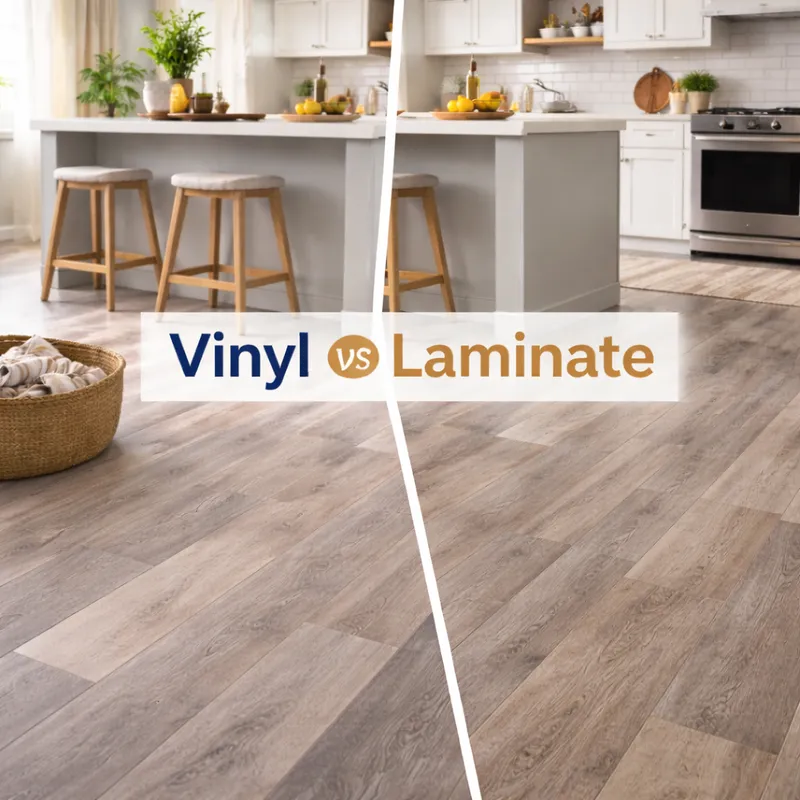
In a real kitchen, vinyl plank wins this fight by a mile for anyone who can’t guarantee a perfectly dry floor and saint‑like cleaning habits. Laminate can work, but only in a disciplined, low‑drama kitchen; vinyl plank is what contractors quietly install in their own busy homes.
| Metric | Vinyl plank (LVP) | Laminate |
|---|---|---|
| Durability | Shaw LVP: 12 mil wear layer with 30‑year limited residential wear warranty; 20 mil with lifetime limited residential wear warranty [1][2]. MSI Laurel LVP passes ASTM F2199 dimensional‑stability testing [3]. WoodChic rigid core LVP: residual indentation ≤0.007″ (0.18 mm) per ASTM F1914, no puncture through wear layer into rigid core, and dimensional stability ≤0.25% / lineal ft (305 mm) per ISO 23999 [4][5][6]. Armstrong LVT meets or exceeds ASTM F1700 [7]. | Pergo Laminate Living Expression Pattern: impact resistance ≥12 N (small ball) and ≥750 mm (big ball) per EN 13329 [8]. Maximum thickness swelling 12% after 24‑hour immersion at 20 °C per ISO 24336 [9]. Static load indentation ≥8 MPa (1160 psi) per NALFA 3.1 [10]. Large ball impact resistance >1,200 mm (47.3 in) per NALFA 3.5 [11]. Laminate durability and water resistance commonly referenced under NALFA/ANSI LF‑01 [12]. |
| Moisture / water resistance | Planks are plastic‑based and not prone to core swelling; WoodChic rigid core LVP exceeds dimensional‑stability requirements with ≤0.25% / lineal ft (305 mm) per ISO 23999 [6]. ASTM F2199 dimensional‑stability pass indicates resistance to curling or size change under heat [3]. Overall assembly still depends on subfloor dryness and joint/perimeter detailing. | Laminate thickness swell <16% per NALFA 3.2 [13] and ≤12% after 24‑hour immersion at 20 °C in Pergo testing [9]. Water‑resistant laminate is explicitly stated as suitable for kitchens when labeled as such [14]. Prolonged or repeated wetting can still cause swelling at joints and edges. |
| VOC emission level (g/L or mg/m³) | Flexco Natural Elements Premium LVP: GREENGUARD Gold, with predicted total VOC 0.22 mg/m³ and formaldehyde 9 µg/m³ [15]. Ter Hürne sōya LVT: GREENGUARD Gold, Eurofins Indoor Air Comfort Gold, and FloorScore, total VOC ≤0.5 mg/m³ after 14 days [16]. WoodChic Premium Designer Flooring is FloorScore Certified [17]. WoodChic rigid core LVP surpasses VOC and formaldehyde requirements per CDPH/EHLB Standard Method v1.2 [18]. | Kaindl laminate flooring total VOC emission ≤300 µg/m³ [19]. Laminate products can be FloorScore certified [20] and carry Greenguard Gold, Blue Angel, and ECO Institut certifications [21]. Laminate meets US EPA TSCA VI and CARB P2 formaldehyde standards per NALFA 3.11 [22]. |
| R‑value / thermal resistance | Total thermal resistance of LVP plus underlayment is typically around R‑1.0 to R‑1.5 [23]. | Thermal resistance 0.15 (m²K)/W per DIN EN 12667 [24]. |
| Maintenance interval (years) | Not established | AC3 laminate supports ~10–15 years of light residential use, AC4 supports ~15–20 years of general domestic traffic, and AC5 supports ~20–25 years in heavier‑use environments [25]. |
| Cost per unit (m² and sq ft), installed | LVP installed typically $9.00 per sq ft, with a range of $3.00–$15.00 per sq ft including materials and labor [26]. Cost per m² not established. | Laminate installed costs $3.00–$13.00 per sq ft, typical $8.00 per sq ft including materials and labor [27]. Cost per m² not established. |
Vinyl plank flooring in kitchens
If you want one floor that quietly handles real life—kids, pets, guests who spill red wine then “forget” to mention it—luxury vinyl plank is the grown‑up choice.

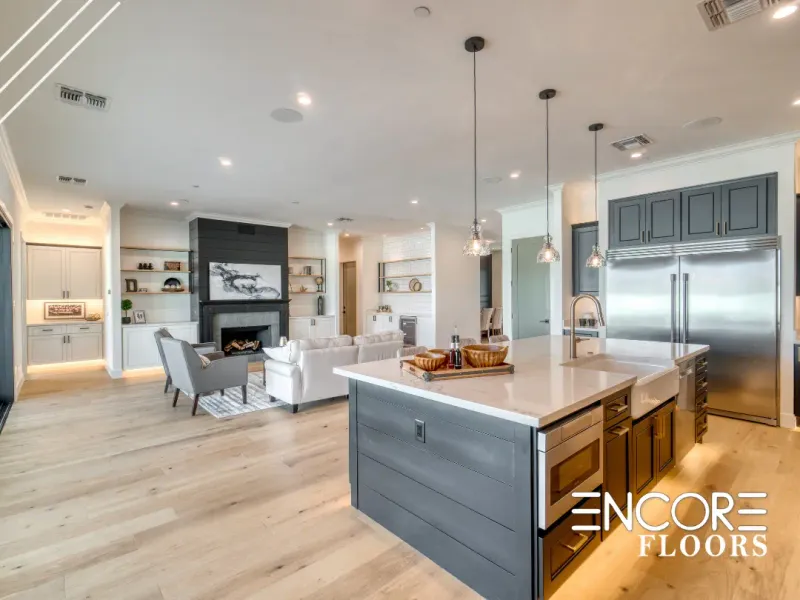
On paper, the durability numbers are strong. A mid‑range LVP with a 12 mil wear layer carries a 30‑year limited residential wear warranty [1], and stepping up to a 20 mil wear layer bumps that to a lifetime limited residential wear warranty [2]. That tells you how confident manufacturers are about surface wear in a normal home. You’re more likely to get bored with the colour than wear through the finish.
Under load and traffic, decent rigid‑core products behave well. WoodChic’s rigid core LVP leaves residual indentation of ≤0.007″ (0.18 mm) after ASTM F1914 testing [4] and shows no puncture through the wear layer into the core [5]. Dimensional stability is tight too, with ≤0.25% movement per lineal foot (305 mm) under ISO 23999 [6]. In plain language: dropped pans, bar stools, chair legs, and daily foot traffic are exactly what this stuff is made for. MSI’s Laurel LVP passing ASTM F2199 for dimensional stability [3] and Armstrong LVT meeting or exceeding ASTM F1700 [7] are more reminders that you’re in the “commercial test standard” world, not “hope it survives Sunday brunch.”
Moisture is where vinyl plank walks away from laminate. The core is plastic‑based, so you don’t have the same “wood sponge” problem at the heart of the board. That ISO 23999 dimensional‑stability limit of ≤0.25% [6] means the boards basically stay the size they’re meant to be, even when the room’s humidity swings. Yes, water can still sneak through joints and edges to the subfloor, but the plank itself isn’t going to swell into a potato chip because a toddler missed the bowl.
Air quality is often raised as a concern with vinyl, and it should be. The good news: kitchen‑grade LVP now comes with serious third‑party emissions credentials. Flexco’s Natural Elements Premium LVP hits GREENGUARD Gold with total VOC at 0.22 mg/m³ and formaldehyde at 9 µg/m³ [15]. Ter Hürne’s sōya LVT stays at or below 0.5 mg/m³ VOC after 14 days and stacks GREENGUARD Gold, Eurofins Indoor Air Comfort Gold, and FloorScore [16]. WoodChic’s lines are FloorScore certified [17] and tested to exceed CDPH Standard Method v1.2 for VOC and formaldehyde [18]. Translation: if you pick the right product, you can have a tough vinyl floor without turning your kitchen into a fumes experiment.
Thermally, LVP plus underlayment adds roughly R‑1.0 to R‑1.5 over the subfloor [23]. That’s not a miracle blanket, but it’s comfortable enough underfoot and generally friendly to radiant systems as long as you follow the manufacturer’s heat limits. Still, check local installers and your heating supplier before betting a whole project on a single R‑value; radiant performance and code compliance are local issues.
Daily life on LVP is pleasantly boring. Sweep or vacuum, then damp mop with a product that doesn’t void the warranty. Because the surface is continuous and non‑porous, you can get away with sloppier mopping than laminate tolerates; the main downside is textured or heavily embossed planks that catch crumbs and greasy film in the grooves. You’ll scrub a little harder in front of the cooker, but you won’t be panicking over every splash.
Cost is where people assume laminate is automatically cheaper. Installed luxury vinyl plank typically runs about $9.00 per sq ft, with a range from $3.00 to $15.00 per sq ft including materials and labor [26]. On a quote sheet, that can look like the “upgraded” option—until you factor in what happens after the first leak. You don’t have to baby the joints, you’re not paying to replace swollen boards at year three, and you’re not obsessing over mats and micro‑mopping. Over a real kitchen lifetime, LVP is usually the cheaper attitude.
If you’re doing a modern white kitchen, vinyl plank is also kinder to the design. Slightly softer wood visuals, mid‑tones, and subtle patterns work better with hard‑lined white cabinets than a hyper‑realistic laminate that shows every puffed seam like a scar. Your kitchen should look good after five winters, not just in the handover photos.
One caveat I’ve seen catch people: LVP needs a very well‑prepared subfloor. That great dimensional stability number of ≤0.25% [6] doesn’t forgive humps, dips, or old adhesive ridges underneath. On an uneven kitchen, budget for levelling and prep, and verify what’s included with your installer—local labour and prep costs can swing more than the material price itself.
Laminate flooring in kitchens
Laminate is the “Instagram choice”: sharp wood visuals, a firm feel underfoot, strong spec sheet numbers—and a temper when it meets water.

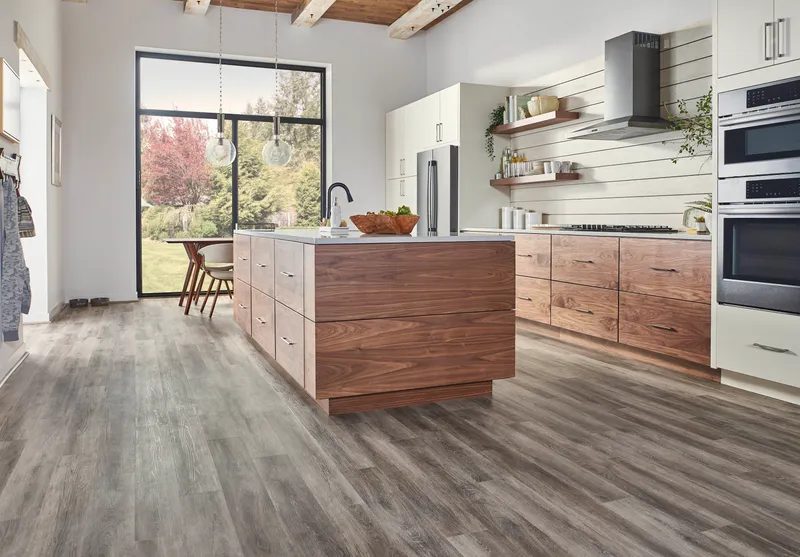
Let’s be fair first. Impact and wear performance can be excellent. Pergo’s Living Expression laminate handles at least 12 N in small‑ball impact and at least 750 mm in big‑ball drop tests under EN 13329 [8]. Classen’s laminate hits ≥8 MPa (1160 psi) in static load indentation per NALFA 3.1 [10] and >1,200 mm (47.3 in) in large‑ball impact per NALFA 3.5 [11]. That’s solid for dropped utensils, chair legs, and busy traffic. AC‑rated boards (AC3 through AC5) stretch from roughly 10–15 years of light residential use up to 20–25 years in heavier‑use environments [25]. On dry floors, laminate is no pushover.
Thermally, laminate offers 0.15 (m²K)/W of resistance per DIN EN 12667 [24]. You’ll feel it as slightly warmer and firmer underfoot than plain tile, and it can work over radiant systems when the manufacturer approves it. Again, check locally with your heating contractor; standards are one thing, warranties in your postcode are another.
The emissions story is also more grown‑up than laminate’s reputation suggests. Kaindl publishes a total VOC emission cap of 300 µg/m³ [19], while other lines carry FloorScore certification [20] and badges like Greenguard Gold, Blue Angel, and ECO Institut [21]. Many laminates also meet US EPA TSCA VI and CARB P2 formaldehyde requirements per NALFA 3.11 [22]. So if your only worry is indoor air, laminate can absolutely sit in a modern, health‑conscious spec.
The crack in the story is water. Yes, the tests look reassuring at a glance. You’ll see numbers like thickness swell <16% per NALFA 3.2 [13], and Pergo’s 12% max thickness swelling after 24 hours’ immersion at 20 °C [9]. That’s lab water, controlled, measured, with edges treated the way the standard dictates.
Your kitchen is not a lab. It’s a slow fridge line leak or a dishwasher that weeps into one corner for a week. In that world, laminate’s wood‑based core has zero sense of humour. I’ve watched “water‑resistant” laminate bubble along every dishwasher and fridge line within three years. Those thickness‑swell numbers [9][13] tell you what happens when water reaches the core; they don’t magically stop it getting there.
Manufacturers are blunt enough between the lines: water‑resistant laminate is suitable for kitchens—when it’s specified as such [14]. That’s code for “don’t put bargain living‑room laminate under your sink.” Even with the right label, you’re signing up for a relationship where you wipe every spill, baby the sink zone, and worry about mats hiding damp patches.
Cost is where laminate tempts people. Installed laminate typically runs $3.00–$13.00 per sq ft, with a common figure around $8.00 including materials and labor [27]. On day one, that may undercut the LVP quote by about a dollar a foot in the middle of the range [26][27]. But here’s the problem: laminate is fake‑cheap in a wet room. Add one plumber’s visit and a round of board replacement around the dishwasher, and you blow through that gap fast. Factor in joint sealants, fussy perimeter detailing, and the fact you can’t just casually wet‑mop, and the “saving” starts to look like a service plan for your own floor.
Durability over time is also more conditional than the AC numbers suggest. Yes, AC5 is tested for roughly 20–25 years in heavier‑use environments [25]. That’s under the standard’s wear conditions, not “two kids, a labrador, and an icemaker leak”. In dry living rooms, that test history is excellent. In kitchens, it’s only as good as your plumbing luck and how quickly you spot a drip.
Where does laminate make sense? In a kitchen that behaves like a dry room: no history of leaks, careful plumbing, highly disciplined cleaning, and an owner who genuinely puts “best wood look” above “low drama”. If you’re that person and you go for high‑spec, water‑resistant laminate with proper edge detailing [13][14][12], it can look fantastic and feel satisfyingly solid. Just don’t tell yourself it’s “basically waterproof”. It isn’t.
Which one should you choose?
I’ll cut through the noise. For most kitchens, vinyl plank wins. The only time I’d deliberately pick laminate is when you know your household behaves more like a gallery than a kitchen.

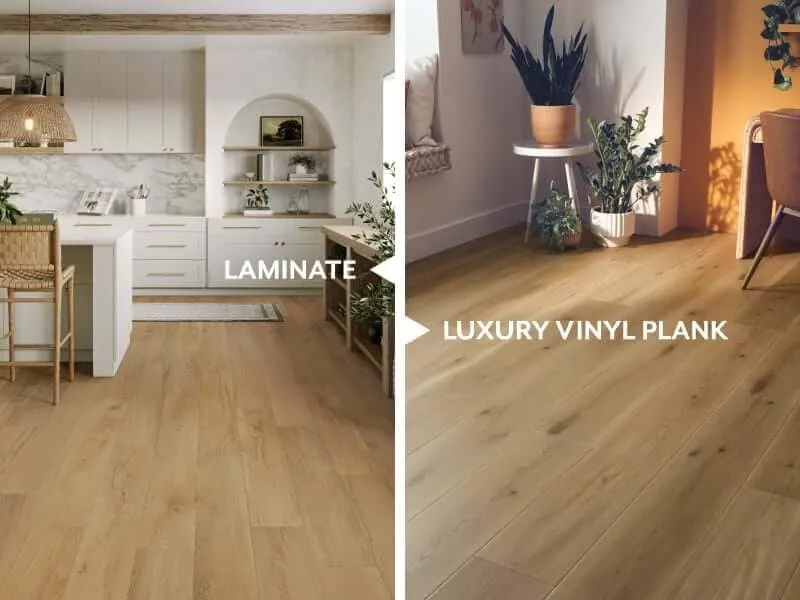
Busy family kitchen (kids, pets, constant traffic)
Pick vinyl plank. Between the lifetime and 30‑year wear warranties on decent LVP [1][2] and its resistance to swelling [6], it’s built for abuse. You can damp‑mop without anxiety and not lose sleep over every stray ice cube. Laminate’s thickness swell numbers [9][13] and wood core turn into a maintenance chore the minute life gets messy.
Open‑plan kitchen with modern white cabinets
Still vinyl plank. You get continuous runs through living and dining areas without worrying about every wet footprint, plus plenty of low‑sheen, mid‑tone options that soften stark white. A puffed laminate seam under a sleek white island is brutally visible, and replacing boards in the middle of an open run is no fun.
Rental or flip where you need durability and low callbacks
Vinyl plank again. Installed cost overlaps heavily—LVP averages around $9.00 per sq ft [26] and laminate around $8.00 per sq ft [27]—but the tenant who mops with a bucket or ignores a slow leak is far less likely to destroy a good LVP floor. Fewer “my floor is ruined” calls, fewer mid‑tenancy repairs.
Design‑led, low‑use kitchen (adult household, minimal cooking)
This is laminate’s one honest niche. If you truly want the crispest wood visual and your kitchen behaves more like a showpiece—clean, dry, lightly used—then a high‑spec, water‑resistant laminate with credentials like NALFA/ANSI LF‑01 [12], swell limits [9][13], and solid emissions certifications [20][21][22] can be justified. But you’re choosing it for looks, fully aware it’s the higher‑maintenance diva.
Underfloor heating and comfort underfoot
Both can work when the product and heating system are approved, but I lean to vinyl plank. LVP plus underlayment giving roughly R‑1.0 to R‑1.5 [23] is generally friendly to radiant warmth while staying comfortable year‑round. Laminate’s 0.15 (m²K)/W thermal resistance [24] is fine, but once you accept that water is your enemy, the system that tolerates damp mopping around a warm floor wins.
Whatever you pick, confirm with local installers and building officials that the product, emissions certifications, and installation method match your codes and climate. A solid lab spec only pays off when the local details are right.
Key facts
Show all 11 rows ▾Hide table ▴
| What it covers | Value | Source |
|---|---|---|
| LVP residential wear warranty (12 mil) | 30‑year limited residential wear warranty [1] | Shaw Floors |
| LVP residential wear warranty (20 mil) | Lifetime limited residential wear warranty [2] | Shaw Floors |
| LVP wear‑layer thickness (premium kitchen‑grade) | 20 mil (0.5 mm) wear layer [28] | WoodChic Floors |
| LVP rigid‑core indentation performance | Residual indentation ≤0.007″ (0.18 mm) per ASTM F1914 [4] | WoodChic Floors |
| LVP rigid‑core dimensional stability | ≤0.25% / lineal ft (305 mm) per ISO 23999 [6] | WoodChic Floors |
| Laminate thickness swell (general) | <16% per NALFA 3.2 [13] | Classen |
| Laminate thickness swell (Pergo kitchen pattern) | Maximum 12% after 24‑hour immersion at 20 °C per ISO 24336 [9] | Pergo |
| LVP indoor air quality best case | GREENGUARD Gold, TVOC 0.22 mg/m³, formaldehyde 9 µg/m³ [15] | Flexco Floors |
| Laminate indoor air quality example | VOC ≤300 µg/m³, various third‑party certifications [19][21] | Kaindl; Classen |
| Typical installed cost range – LVP | $3.00–$15.00 per sq ft, typical $9.00 per sq ft [26] | Koira |
| Typical installed cost range – laminate | $3.00–$13.00 per sq ft, typical $8.00 per sq ft [27] | Koira |
Quick answers
Is vinyl plank more durable than laminate in a kitchen?
For surface wear and day‑to‑day abuse, good vinyl plank is more forgiving in a kitchen: 12 mil LVP carries a 30‑year limited residential wear warranty and 20 mil reaches a lifetime limited warranty [1][2], while rigid‑core products show very low residual indentation (≤0.007″/0.18 mm) and tight dimensional stability (≤0.25% per lineal ft/305 mm) [4][6]. Laminate can be tough on impact [8][11], but its wood core is far more vulnerable to moisture‑driven swelling [9][13].
Which is better for water resistance: vinyl plank or laminate?
Vinyl plank wins for water tolerance in kitchens: its plastic‑based core and dimensional stability of ≤0.25% per lineal ft (305 mm) [6] mean routine splashes are far less likely to cause swelling. Water‑resistant laminates limit thickness swell to <16% [13] or around 12% in some tests [9], but once water reaches the core, damage is often permanent.
Is vinyl plank or laminate cheaper to install in a kitchen?
Up front, laminate is usually slightly cheaper, with installed costs of $3.00–$13.00 per sq ft and a typical figure around $8.00 per sq ft [27], versus LVP at $3.00–$15.00 per sq ft and a typical $9.00 per sq ft [26]. Over time, though, vinyl plank often works out cheaper in real kitchens because you’re less likely to pay for swollen laminate board replacement after leaks.
How long will laminate last in a residential kitchen?
On paper, AC3 laminate is rated for roughly 10–15 years of light residential use, AC4 for 15–20 years of general domestic traffic, and AC5 for 20–25 years in heavier‑use settings [25]. In a kitchen, those lifespans only hold if water exposure is tightly controlled; repeated wetting or hidden leaks can shorten them significantly.
Which flooring is better for indoor air quality in kitchens?
Both can meet high indoor air standards: LVP lines like Flexco’s GREENGUARD Gold product keep TVOC around 0.22 mg/m³ with 9 µg/m³ formaldehyde [15], and some LVTs cap total VOC at 0.5 mg/m³ after 14 days with multiple certifications [16]. Laminate options publish limits like 300 µg/m³ VOC [19] and carry FloorScore, Greenguard Gold, Blue Angel, and ECO Institut marks [20][21]. Your best move either way is to choose a branded product with clear third‑party certification and confirm it aligns with your local regulations.
Can laminate be used safely in kitchens?
Yes, but only if you use water‑resistant laminate that is explicitly stated as suitable for kitchens [14], install it to NALFA/ANSI standards [12], and keep water exposure brief and controlled relative to its thickness‑swell limits of <16% or ~12% in testing [13][9]. If you expect slow leaks, heavy wet‑mopping, or lax spill cleanup, vinyl plank is the safer and more forgiving choice.
Sources
Facts last verified 2026-10-30.
- Shaw 12 mil luxury vinyl flooring has a 30-year limited residential wear warranty. — Shaw Floors, retrieved 2026-10-30.
12 mil products have a 30 year limited residential warranty and a 7 year light commercial warranty.
- Shaw 20 mil luxury vinyl flooring has a lifetime limited residential wear warranty. — Shaw Floors, retrieved 2026-10-30.
20 mil products have a lifetime limited warranty and a 10 year light commercial warranty.
- MSI Laurel luxury vinyl plank passes ASTM F2199 dimensional-stability testing. — MSI Surfaces, retrieved 2026-10-30.
**ASTM F2199 (Dimensional Stability)**: Passes
- WoodChic Rigid Core Luxury Vinyl Plank Flooring Surpasses Requirements for Residual Indentation with an average of ≤0.007” (0.18mm) per ASTM F1914. — WoodChic Floors, retrieved 2026-10-30.
ASTM F1914 Residual Indentation Average: ≤0.007” (0.18mm) Surpasses Requirements
- WoodChic Rigid Core Luxury Vinyl Plank Flooring Surpasses Requirements for Surface Integrity with no puncture through wear layer/décor into rigid core per ASTM F1914. — WoodChic Floors, retrieved 2026-10-30.
ASTM F1914 Surface Integrity No puncture through wear layer / décor into rigid core Surpasses Requirements
- WoodChic Rigid Core Luxury Vinyl Plank Flooring Surpasses Requirements for Dimensional Stability of ≤0.25% / lineal ft. (305 mm) per ISO 23999. — WoodChic Floors, retrieved 2026-10-30.
ISO 23999 Dimensional Stability ≤0.25% / lineal ft. (305 mm) Surpasses Requirements
- Armstrong luxury vinyl tile meets or exceeds ASTM F1700 requirements for solid vinyl floor tile. — Armstrong Flooring, retrieved 2026-10-30.
Armstrong Flooring™ Luxury Vinyl Tile meets or exceeds the performance requirements of ASTM F 1700, Standard Specification for Solid Vinyl Floor Tile.
- Pergo Laminate Living Expression Pattern has an impact resistance of at least 12 N for small-ball testing and at least 750 mm for big-ball testing. — Pergo, retrieved 2026-10-30.
Impact resistance
EN 13329
Small ball
≥ 12N
≥ 12N
Big ball
≥750mm
≥750mm - Pergo Laminate Living Expression Pattern has maximum thickness swelling of 12% after 24-hour immersion at 20°C. — Pergo, retrieved 2026-10-30.
Thickness swelling
ISO 24336
After 24h immersion at 20°C
≤ 18%
≤ 12% - Laminate flooring has a static load indentation result of ≥ 8MPa (1160psi) per NALFA 3.1. — Classen, retrieved 2026-10-30.
Static Load (indentation) NALFA 3.1 ≥ 8MPa (1160psi)
- Laminate flooring has a large ball impact resistance of > 1,200 mm (47.3 in) per NALFA 3.5. — Classen, retrieved 2026-10-30.
Large Ball Impact Resistance NALFA 3.5 > 1,200 mm (47.3 in)
- NALFA/ANSI LF-01 is a common standard cited for the usage and certification level of laminate flooring. — Classen, retrieved 2026-10-30.
Usage & Certification Level NALFA/ANSI LF-01 Commercial, Certification Level 3 *
- Laminate flooring has a thickness swell of < 16% per NALFA 3.2. — Classen, retrieved 2026-10-30.
Thickness Swell NALFA 3.2 < 16%
- Water-resistant laminate flooring is suitable for installation in kitchens. — Koira, retrieved 2026-10-30.
Water-resistant laminate can go in kitchens.
- Flexco Natural Elements Premium Luxury Vinyl Plank has GREENGUARD Gold certification, with a maximum predicted total VOC concentration of 0.22 mg/m³ and formaldehyde concentration of 9 µg/m³ under the certification criteria. — Flexco Floors, retrieved 2026-10-30.
0.22
mg/m³
Formaldehyde
50-00-0
9 (7.3 ppb)
µg/m³ - The ter Hürne sōya luxury vinyl tile product is certified with GREENGUARD Gold, Eurofins Indoor Air Comfort Gold, and FloorScore, with total VOC emissions no greater than 0.5 mg/m³ after 14 days. — ter Hürne, retrieved 2026-10-30.
SŌYA Pro and FRIENDS Dryback flooring are certified with GREENGUARD Gold, Eurofins Indoor Air Comfort Gold and FloorScore
○R Label.
The total VOC emissions of the products are no more than 0.5 mg/m3 a… - WoodChic Premium Designer Flooring is FloorScore Certified by SCS Global Services. — WoodChic Floors, retrieved 2026-10-30.
Certification: FloorScore Certified by SCS Global Services
- WoodChic Rigid Core Luxury Vinyl Plank Flooring Surpasses Requirements for VOCs/TVOCs and Formaldehyde per CDPH/EHLB, Standard Method v1.2. — WoodChic Floors, retrieved 2026-10-30.
CDPH/EHLB, Standard Method v1.2 VOCs/TVOCs, Formaldehyde Refer to Standard Surpasses Requirements
- Kaindl laminate flooring has a published total VOC emission limit of no more than 300 µg/m³. — Kaindl, retrieved 2026-10-30.
TVOC ≤ 300 μg/m³
- Grand Selection laminate flooring has FloorScore certification for volatile organic compound and formaldehyde emissions. — Grand Selection, retrieved 2026-10-30.
With the FloorScore certification, each of our floors meets the strict requirements for volatile organic compounds (VOC) and formaldehyde emissions for classrooms and offices.
- Laminate flooring is certified with Greenguard Gold, Blue Angel, and ECO institut certifications. — Classen, retrieved 2026-10-30.
CERTIFICATION Greenguard Gold Blue Angel, ECO institut
- Laminate flooring meets US EPA TSCA VI & CARB P2 TPC Certified Compliant formaldehyde emission standards per NALFA 3.11. — Classen, retrieved 2026-10-30.
Formaldehyde emission standards NALFA 3.11 US EPA TSCA VI & CARB P2 TPC Certified Compliant
- The total thermal resistance of luxury vinyl plank flooring plus underlayment is typically around R-1.0 to R-1.5. — New Brunswick Flooring, retrieved 2026-10-30.
The total thermal resistance (R-value) of the LVP plus underlayment should not exceed the manufacturer’s maximum — typically around R-1.0 to R-1.5.
- Laminate flooring has a thermal resistance of 0.15 (m²K)/W per DIN EN 12667. — Classen, retrieved 2026-10-30.
Thermal resistance DIN EN 12667 0.15 (m2K) / W
- AC3-rated laminate flooring supports approximately 10–15 years of light residential use, AC4 supports 15–20 years of general domestic traffic, and AC5 supports 20–25 years in heavier-use environments. — Tile Mountain, retrieved 2026-10-30.
AC3-rated laminate supports approximately 10–15 years of light residential use, AC4 supports 15–20 years of general domestic traffic, and AC5 extends lifespan to 20–25 years in heavier-use environment…
- Luxury vinyl plank (LVP) flooring, installed, typically costs $9.00 per sq ft, with a range of $3.00 to $15.00, including materials and labor. — Koira, retrieved 2026-10-30.
Luxury vinyl plank (LVP), installed $3.00 to $15.00 a sq ft (typical $9.00) HomeAdvisor (vinyl) $2 to $14, Modernize (LVP) $4 to $16. Averaged. Materials and labor together.
- Laminate flooring installation costs $3 to $13 per square foot, with a typical cost of $8, including materials and labor. — Koira, retrieved 2026-10-30.
By the square foot, HomeAdvisor put it at $3 to $13, with $8 in the middle.
- WoodChic Premium Designer Flooring Collection: Essence has a wear layer of 20mil (0.5mm). — WoodChic Floors, retrieved 2026-10-30.
Wear Layer: 20mil (0.5mm)
The post Vinyl Plank vs Laminate Flooring for Kitchens: The Clear Winner Contractors Recommend appeared first on DesignRulz.