There was never any question about rebuilding when a treasured lakeside home burnt down, and its replacement pays joyful tribute.
Lake Ōhau doesn’t invite you to slow down — it makes you. Framed by mountains and sky, it’s a place where time stretches out and life settles into a slower rhythm. That’s what drew Janet Muir and Richard Brown here, and what made them stay.
When fire tore through the valley in 2020, reducing their home to ash, the decision to rebuild was almost instant. This place had shaped their life. Leaving wasn’t an option. “The light, the space, the sense of solitude,” says Janet. “It all felt right.”


Their first home was a creative, considered space by architect Lisa Webb of Studio LWA, a long-time friend who understood both the site and the spirit behind it. She returned to design its successor, not as a replacement but as a continuation. “There were a lot of decisions that didn’t need to be spoken about,” says Lisa. “It was just understood.”


What followed was a collaborative process guided by trust and clarity. The new house follows the footprint of the first, with one key evolution: the addition of a mezzanine, which introduces a second living area, Janet’s office and a sleeping nook — creating breakout zones for when the house is full of people.


In the first iteration, a garage had doubled as a games room for their children, but this time the layout offered greater flexibility, without increasing the home’s overall size.


For Brown House 2.0, the couple navigated constraints of time, money and the rising cost of building. Re-creating the original in full wasn’t possible, nor was it the goal. Instead, they turned to what mattered, stripping back what didn’t and letting that guide the design.


The revised structure alters the shape of the home significantly. “The first house had that acute gable that lifted at one end — expressive, but not essential,” says Lisa. “This time we unified the massing. It’s one solid form that’s more grounded. Less a statement, more a shelter.” Its solid form and red-scoria finish give it an unmistakable presence in the landscape. Rather than replicate what was lost, the layout was simplified to reflect what they knew they needed: nothing more, nothing less. “There’s a confidence that comes from living with a design and knowing what works,” says Lisa.

That understanding also informed the way space was allocated. They skipped an ensuite, reducing repetition and prioritising shared space. Bathrooms are compact and communal, allowing room elsewhere for circulation to feel generous where it counts. “There’s something about not overdoing it that helps a house perform better,” says Lisa. The plan supports both solitude and sociability. It works just as well for two as it does for a house full of friends — or guests, when it’s listed for stays.
Richard (known to most as Brownie) took on much of the building work himself through his business, Henry Brown & Company, just as he had the first time. His passion for the project and hands-on approach shaped the home in a way that feels both personal and grounded.

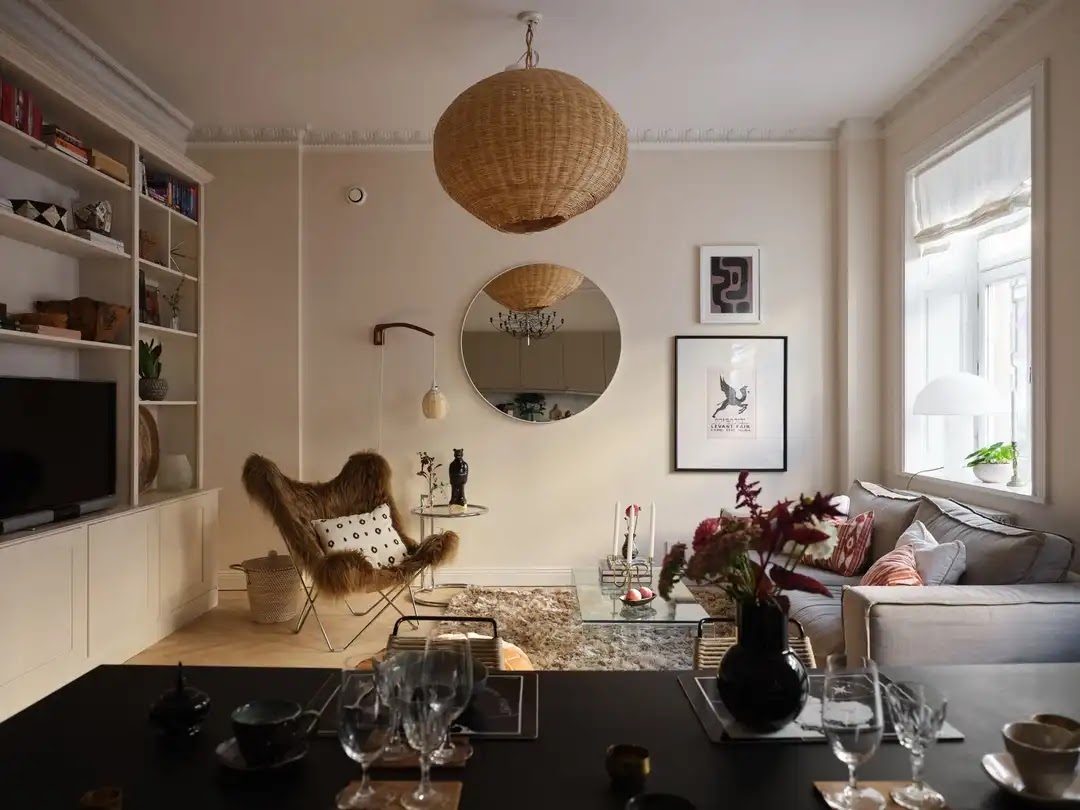
for extra guests. A Wilson & Dorset stone set adds comfort and can be tossed about for lounging.
Their approach to materials reflects the same thoughtfulness. Where the first house was about craft, this second build is about economising. Structural insulated panels (SIPs) provide thermal performance and construction efficiency. In turn there’s
a certain honesty to the interior. Fire-resistant elements, such as steel cladding, were introduced as a practical response. “There’s beauty in building with materials that don’t pretend to be something else,” says Lisa. “And a comfort in letting the structure show.”
Views are carefully framed to draw in the alpine surroundings. Sliding doors can be left open to enhance connection or closed to offer retreat. It doesn’t try too hard. It simply makes space to settle in. “We reused things we loved and found a few new ones along the way,” says Janet. Among them was a series of artworks painted by Janet after finding her groove as a painter again. “It’s not a story about the fire,” she says. “It’s about life going on.”

Lisa approached the project with the sensitivity of someone who knows her clients deeply. “It didn’t need to be a reinvention,” she says. “It needed to feel like it had always been there.” And while the house could be described in architectural terms as modest, pragmatic or even minimalist, its strongest quality is the connection to Ōhau for the couple and their two boys — Harvey (18)
and William (17).
The process wasn’t about overcoming adversity so much as honouring a relationship to place. The land still held meaning. The routines of life — coffee in the morning sun, afternoons spent out and about around the lake or up on the ski slope, evenings back at the house filled with friends — still mattered.
What Janet and Lisa have created together, and what Richard’s hands have brought to built reality, is a home that reflects those values — and one that welcomes others to experience them, too.
Words Alice Lines
Photography Biddi Rowley
The post Back in bold: A scoria-red second act at Lake Ōhau appeared first on homestyle magazine.