In a quiet corner alongside the Mangawhai estuary, this new home, anchored by memories and a heavy stone wall, has presence beyond its years.
Bev Worsfold knows the numbers: 22 family members who live within 10km of her home in Mangawhai equals infinite opportunities for catch-ups (spontaneous or otherwise). This is one grandma who is never going to be at risk of social isolation.
Not that there isn’t someone she still misses seeing. Bev’s husband, Bill, with whom she began this project a decade ago, dreaming of a new house for land they had purchased in the early 2000s, sketching up ideas and “prancing around with chairs” trying to envisage how the spaces would fit, died in 2017. “After that, I thought, ‘Will I continue on?’” says Bev. And, eventually, she did.

Her friend Peggy Deamer was instrumental in pushing things forward. An architecture professor at Yale, Peggy now divides her time between New York and a holiday home on two hectares in the Kaipara. The pair bonded over a love of design and sustainable land management, and one day over coffee Peggy said, “I’d like to help you.”


The process began by moving an original Keith Hay bach to Bill’s family farm — a place originally settled by his great-grandparents in the 1860s. Then Peggy put a concept plan together. “She did great things,” says Bev. “I could see the floorplan, but couldn’t think how to put the roof on.”

Having built an architectural farmhouse in the late 1970s, designed by Stuart Scott of Archangel — a foray that was all “terribly exciting and hippy and alternative at the time” — Bev knew she wanted a layout that lent itself to big gatherings, yet one she wouldn’t rattle around in when home alone. Bev helped develop Aotearoa’s second-largest native plant nursery, so top priority was also plenty of easy connection to the outdoors. “I find it hard to be inside for too long,” she says.


The crunch of gravel now alerts Bev to the frequent visitors to her estuary-front home. This pathway is flanked on one side by a pittosporum hedge, on the other by a stone spine the colour of sand, which crosses the threshold to slice right through the centre of the plan. Eye-catching and textural alongside the extra-wide hallway, it’s evocative of Grecian summer houses, but has its roots in far colder climes. “Bill had thought earth-bricks, but that all felt too hard to maintain,” says Bev. The croft homes of the Orkney Islands lingered in her memory. Stone it was.


The limestone brings a feeling of permanence to the dwelling, which Bev wanted to feel like a fisherman’s cottage rather than “a flash new house”. Now that the project was on the move, she was rather excited to get stuck in choosing fittings, fixtures and furniture. The aesthetic mood was based on earthenware pots she’d had since the 1970s: earthy in tone and feel. “Those pots still hold real meaning for me.”

Bev was 21 when she and Bill built their first house together. Remembering that experience, she thought, ‘This is going to be so much fun’. It wasn’t. She found the decision-making exhausting. Interior designer Leslie Scott of Project Design, who lives nearby, stepped up. “I was involved at plan stage, digesting the brief,” explains Leslie. “And then with material sourcing and, in the later stages, when Bev’s builder Steve tragically died, taking the project through to compliance.”

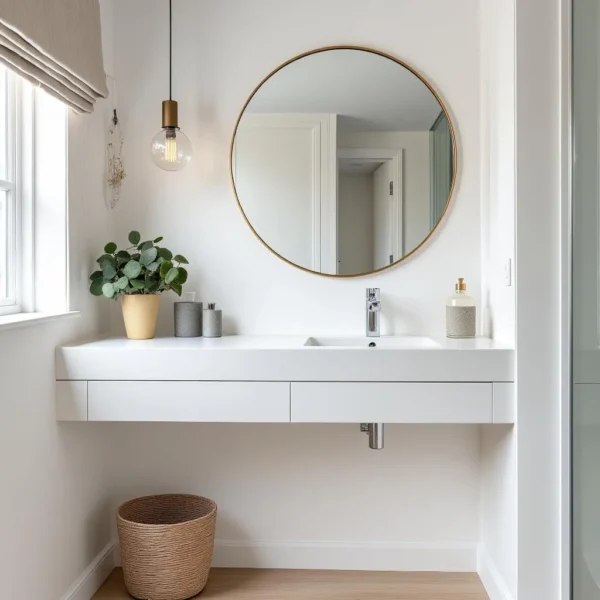
In the kitchen, Leslie pushed Bev to embrace something a bit different. Honey-toned Calacatta Gold benchtops echo the white/gold spine, bayleaf-green cabinetry brings in Bev’s favourite colour and splashback tiles in beige and brown are a beautiful feature. “The tiles have just the right amount of gloss,” says Leslie. “This space seemed to want the square format, but we used them subway style in the bathrooms.”


The kitchen is a study in farmhouse chic, with Bev’s beloved pottery jars in pride of place on open shelving. Doors open to a walk-in pantry and laundry (an indulgence Bev had never enjoyed before), then on to her flourishing cottage garden.

In the adjacent dining area, a round antique oak table has been paired with $5 chairs bought from The Warehouse many years ago. While Bev had thought of replacing them, it wasn’t her main concern. Her focus was on blending a few key old pieces with modern ones, so that the home wouldn’t look like “a large motel unit” — and she was far more interested in crafting shelves to display keepsakes with cupboards for a trimmed-down library.

“We conceived the shelving unit in the dining room at the end of the build, when the budget was drying up,” explains Leslie. “We chopped up three bookcases and two sideboards from a discontinued range and had a timber top made to match.” A German pottery lamp, a fraction of Bev’s book collection and a Kitty Vane watercolour are part of the anthology of treasures.
Along the hall, punctuated by a rhythm of deep-set doorways, the main bedroom has the farmhouse feel of pretty-print wallpaper teamed with blush-toned paint. The bedside lamps, however, lean into the modernist.


“I think Bev’s love of vintage furniture, mid-century design and the chance to embrace a feminine feel has culminated in the bedroom,” says Leslie. Heavy-weave drapes, a bouclé headboard and a velvet coverlet tie the scheme together.
The capacious room is equalled in size by Bev’s dressing room. “I had so many years in a terribly small bedroom that this may be overkill,” she admits. But it’s all relative. When her 10 granddaughters pile in at once to join her in dress-ups, chattering with the excitement and energy of youth, the extra space means money well spent.
Still, it’s good to know that in the evenings she can banish the youngsters to their bunkroom above the carport. Then she’ll settle in front of the fireplace — cosy, calm and ready for tomorrow, when she’ll welcome them again, eyes and arms wide open.
Words Claire McCall
Photography Larnie Nicolson
The post A Mangawhai home shaped by gathering appeared first on homestyle magazine.



.jpg)


